
Red Light Recovery
The Red Light Recovery Room: Austin's Next At-Home Wellness Space Upgrade
Search "red light therapy" right now and you'll get a wall of panels, mats, and masks, buying guides ranking the best device to order to your door. What you won't find much of is the other half of the story: a growing number of homeowners aren't buying a panel and propping it against a bedroom wall. They're building a room for it, the same way they'd build a sauna or a cold plunge alcove. That gap, between "gadget you buy" and "space you design", is exactly where the next at-home wellness space upgrade is happening, and Austin is a good place to watch it land first.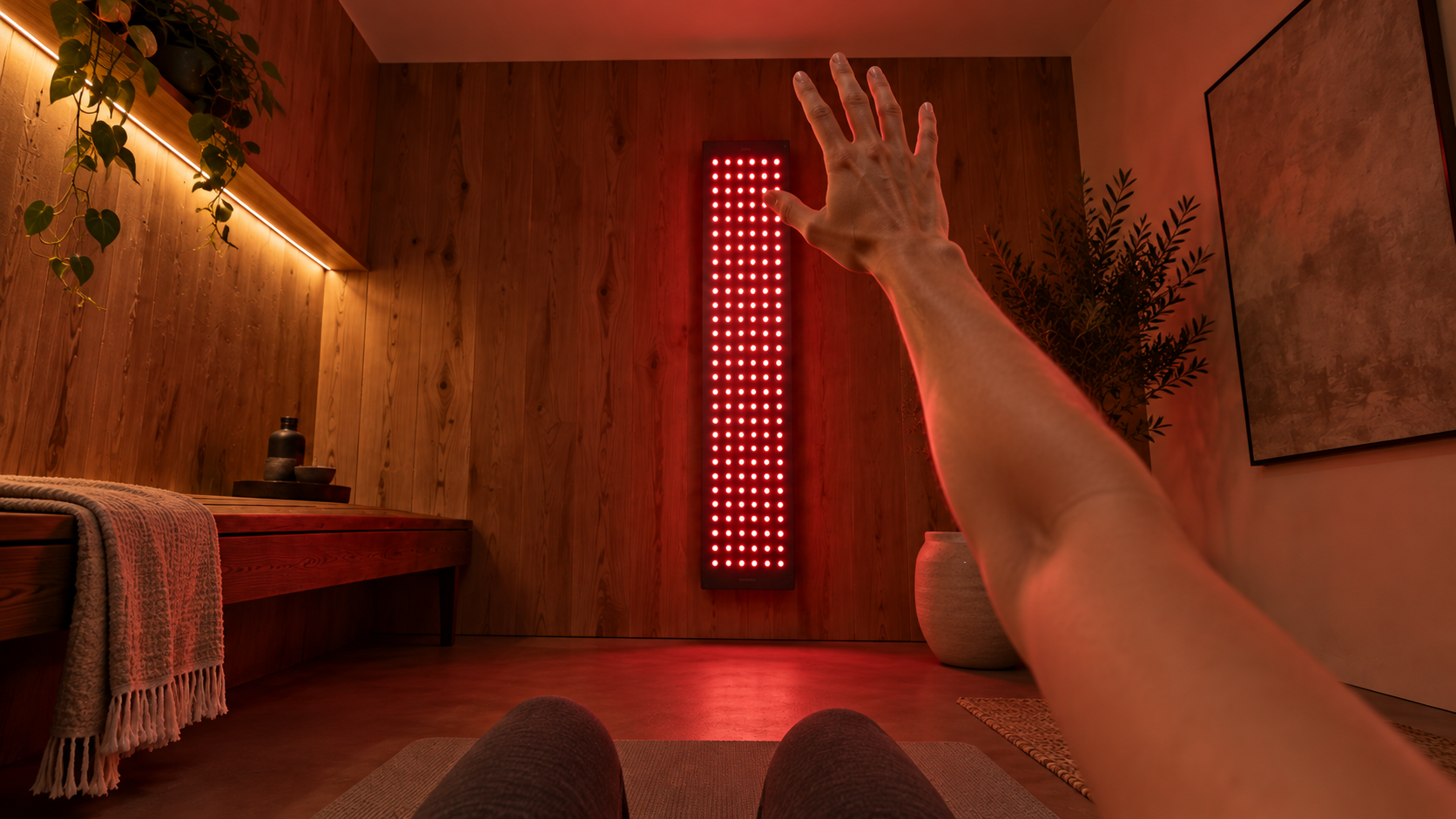
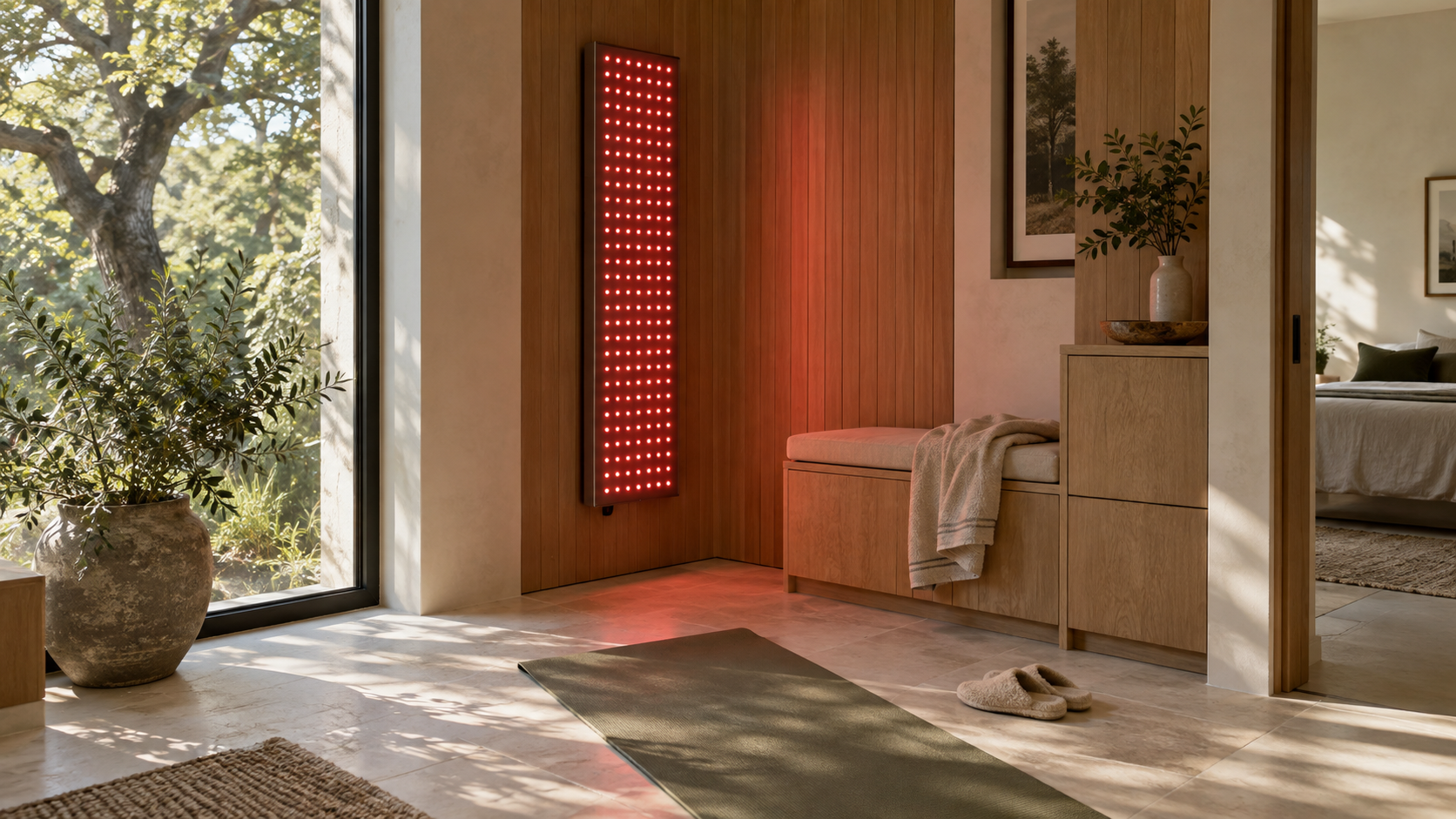
First-person view of a wood-paneled recovery room with a glowing red light therapy panel, built-in bench, and warm lighting.
Red light therapy just became a real estate trend, not just a gadget.
The numbers explain why this is showing up in home design conversations at all. The U.S. red light therapy bed market was valued at roughly $69 million in 2024, is projected to hit $84.7 million in 2025, and is forecast to approach $200 million by 2033, an 11.2% compound annual growth rate (Global Wellness Institute, May 2026). That's happening alongside a broader wellness real estate boom: the global wellness real estate market hit $876 billion in 2025, up from $711 billion the year before, growing at roughly 23% annually, nearly eight times the pace of general construction (Global Wellness Institute, 2026).
Adoption at the top of the athletic and hospitality world is accelerating the trend downstream. The Global Wellness Institute's May 2026 report on athletic recovery notes elite athletes, including reported high-dollar recovery routines from athletes like LeBron James, and pro teams such as the LA Rams and Liberty's women's basketball program building red light protocols into recovery work, while hospitality brands are adding dedicated recovery suites to spa menus. When elite recovery infrastructure trickles into luxury hospitality, residential design is usually next.
“Recovery is no longer passive. It’s intentional, science-backed, and it’s the new frontier of athletic performance and wellness travel.”
What the research actually shows
Photobiomodulation (the clinical name for red and near-infrared light therapy) isn't new, but the data behind it has gotten more rigorous. A controlled study cited by the Global Wellness Institute found athletes using red light therapy reported 47% less muscle soreness at 48 hours compared to a placebo group, and a 2021 systematic review found it consistently lowered creatine kinase levels - a blood marker of muscle fiber breakdown. A 2024 meta-analysis found reductions of up to 40% in inflammatory markers (CRP and IL-6) in controlled trials, and separate research found gains of roughly 12% in muscle performance alongside 36% less measured muscle damage versus controls.
Worth saying plainly: this is recovery-support research, not a medical treatment claim, and anyone managing a specific health condition should talk to a physician before starting a therapy routine. But for general recovery and wellness use, the evidence base has moved well past "wellness fad" territory.
Why most red-light content skips the room entirely
Sauna and cold plunge content has largely matured into design content - ventilation requirements, drainage, materials, placement. Red light content hasn't gotten there yet, mostly because it's cheap and portable enough that most people just buy a panel. But a panel propped in a closet is a very different experience than a dedicated room: better light coverage, actual privacy, and, critically, a space that can be paired with the rest of a recovery routine instead of treated as one more device competing for outlet space.
“Rather than treating buildings as neutral backdrops, neuroarchitecture recognises them as active participants in human health.”
Designing a red light recovery room that actually works
A handful of things separate a real red light room from a panel-in-a-corner setup:
Electrical capacity. Full-body panel arrays can draw meaningfully more power than a single plug-in unit; a dedicated circuit avoids tripped breakers and lets a room run more than one panel.
Heat and airflow. Panels run warm during extended sessions. Rooms need ventilation sized for that heat load, not just general HVAC — especially important in Austin, where a poorly ventilated interior room can get uncomfortable fast in summer.
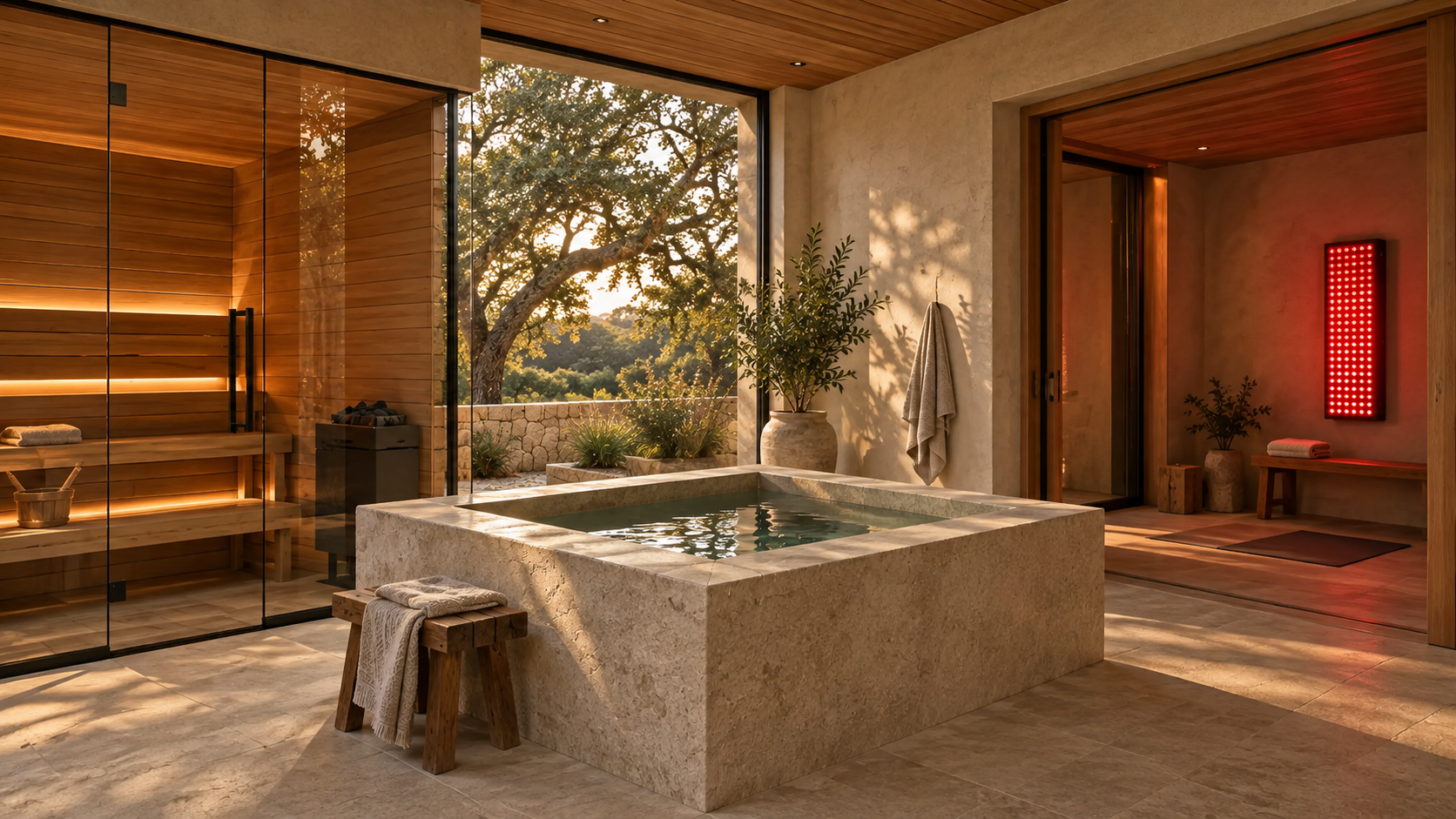
Placement in the recovery flow. The strongest layouts put the red light room adjacent to a home gym or sauna/cold plunge area, so recovery becomes a circuit rather than a separate errand.
Material choices. The Global Wellness Institute's 2026 architecture trend report flags a broader shift toward "plastic-conscious interiors" — natural fiber textiles, solid wood, and low-emission finishes. That fits naturally in a recovery room where you're lying down in low light for 10–20 minutes at a time.
Lighting control and privacy. Sessions work best with dimmable ambient lighting and a door that closes — not incidental to a hallway or shared space.
Storage for eye protection. Simple, but easy to forget at the framing stage: a shallow built-in or drawer near the panel keeps protective eyewear from disappearing into a drawer somewhere else in the house
Built for Austin: the demand is already here
Austin doesn't need to be convinced red light therapy works, the city already has multiple dedicated studios offering it, from recovery-focused practices to cryotherapy and sports medicine clinics. That's a market signal most cities don't have yet: people are already driving across town and paying per session for something that could instead be a five-minute walk from their bedroom.
It also pairs naturally with the climate-driven design approach that keeps proving out in our own project conversations, shade and airflow as the top feature, contrast therapy suited to Austin heat, and ventilation sized for humidity rather than borrowed from a cooler-climate blueprint. A red light recovery room slots in as a natural extension of a sauna or cold plunge build already in progress, not a separate project.
What to expect
Costs vary widely depending on whether you're outfitting an existing room with panel arrays or building a dedicated space from scratch, and we won't pretend there's one number that applies to every home. (We went deep on honest sauna and cold plunge cost/resale numbers in last week's piece, the same "get real data before you commit" approach applies here.) The realistic range starts well below a full sauna or cold plunge build for a panel-only setup, and scales up from there depending on electrical work, ventilation, and finish choices.
The takeaway
Red light therapy has already won the "is this real" argument, the research, the market growth, and the athlete and hospitality adoption all point the same direction. What hasn't happened yet is the design conversation: most homeowners are still treating it like a gadget instead of a room. For Austin homes already building out a wellness space, that's the opening.
Ready to see what a red light recovery room could look like in your home? Schedule a consultation with Tranquilo Space to talk through layout, electrical, and how it fits alongside a sauna or cold plunge build.
Sources cited
Let There Be Light: How Red-Light Therapy Is Transforming Athletic Recovery — Global Wellness Institute, May 2026 (market size/growth stats, clinical stats, athlete/hospitality adoption)
Wellness Real Estate Market — Global Wellness Institute (global wellness real estate market size/growth)Wellness Architecture & Design Initiative Trends for 2026 — Global Wellness Institute, April 2026 (materials/microplastics-reduction trend)The Billion-Dollar Glow: Red Light Therapy's Astounding Rise — Forbes Vetted, Feb 2026 (evidence that mainstream coverage is product/panel-focused — the gap this piece fills)Local Austin red light/recovery studios referenced generically as a market-demand signal (Austin Red Light Therapy, Restore Hyper Wellness, Cryo Body Works, Dynamic Sports Medicine) — found via search; not partners of Tranquilo, no affiliation implied or claimedhttps://globalwellnessinstitute.org/global-wellness-institute-blog/2026/05/28/let-there-be-light-how-red-light-therapy-is-transforming-athletic-recovery-and-what-it-means-for-hospitality-wellness/https://globalwellnessinstitute.org/global-wellness-institute-blog/2026/04/07/wellness-architecture-design-initiative-trends-for-2026/
